Before I begin, I want to just say thank you to everybody who read and responded to my previous blog post. It was so reassuring to discover that my career and life dilemmas were not unique to me, and I massively appreciated all of the advice! One friend in particular had been in a very similar situation, and her advice was so useful that I'm sure she won't mind me sharing it on here.
She got a gap year job with Deloitte after she'd finished sixth form, a scheme whereby she worked for them for half a year and earnt money, and they'd then pay for her to go travelling for the rest of the year. They then paid for her university fees as long as she worked for them in the holidays. And she hated it. She hated it with a passion that meant she'd often pretend to be ill so as to avoid going in to work.
She rebelled against the corporate world, and vowed not to become one of the miserable people she worked for, who hated their jobs but felt they couldn't leave because they, or their families, had become accustomed to a certain sort of lifestyle that the salary afforded. She saw her other option as to keep travelling, move to Australia and pick fruit in various places and move from job to job and project to project. Needless to say, the Durham careers service were appalled to hear about her life plans, and she herself began to think about the life of a nomad- freedom perhaps, but insecurity, no roots, no real chance to establish relationships, have children.... Things that might not seem important to some people but mattered to her, and that matter to me.
She now has a job at Marie Curie and is loving it. I fully expected her to tell me to sack off my job and go right into the charity sector but interestingly, she didn't. She told me there were several important differences in our situations. Firstly, I didn't hate my internship with kpmg, in many ways I enjoyed it. Secondly, she was working in the tax department which is pretty evil, helping companies avoid paying tax etc. My sector can, perhaps, be justified ethically. Thirdly, she said one of the major reasons for her securing her job at Marie Curie was because she did have corporate experience and certain useful skills from Deloitte. She advised me to take up my job, see how I found it, save up some money and then reevaluate. But what was most important was to never feel as though I couldn't leave if I wanted to. To never feel trapped in a job because it was easier, or it paid more. I think this is such excellent advice, and it has made me feel so much better and more at peace with myself. I can now go into house hunting in London with a happier heart.... Although of course things may well change after South America, after all, 6 months is a long time....
So yes, this is stage 2 of the adventures!! I'm currently on my couch for the next 3 nights, in MIAMI BABY...!! I'm not afraid to say that I'm pretty terrified about this next stage of my adventures. Scandinavia was a doozy really, when you think about it. Part of the EU, one of the lowest crime rates in the world, police you can trust and a short hop home should anything go wrong. South America is none of those things. Venezuela, where I'm spending the first 11 weeks, is known as the kidnapping capital of the world, and the police are notoriously corrupt. When I called up to get travel insurance, I had to inquireinto their kidnapping and hostage cover. Apparently they don't pay the random, but they'll pay for my parents to come out a negotiate with my kidnappers (I kid you not). Oh but apparently I shouldn't be too worried- they usually only keep people for a day or two. Great. If you want to see what might happen to me watch a film called 'Hostage', I haven't watched it as I'm afraid it'll make me overly paranoid but yep, that's where I'm headed....
Nah I'll be fine, they usually only kidnap rich Venezualan kids apparently- I'd like to think they'd avoid me as if I were kidnapped it would cause somewhat of a stir in the British press (I hope).
Anyway, plans. 3 nights here in Miami (new years eve woop woop!) and then flying to Venezuela to take part in an intensive Spanish course, which also includes getting my next scuba diving qualification (Rescue diver), hikes in the national park, kayaking expeditions and travelling to Angel Falls, the world's highest waterfall (and where they go to in Up!) I'll be doing the course with about 10 other people on a stunning Caribbean beach and it will hopefully give me the language skills to be able to get by on the rest of the continent. I hope Spanish is easy!
So my plans after Venezuala are pretty loose, I'm hoping to just meet some cool people and head where they're headed. On my to go to list though are:
Lost city trek (Columbia)
Amazon rainforest (Ecuador or Peru)
Maccu picchu (Peru)
Cuzco and allequipa (Peru)
Lake tititca (Bolivia)
Buenos aeries (Argentina)
And I'm flying back from Rio (Brazil)
Anywhere else I should definitely hit? Let me know :)
So here I am. A little tired, a little jet lagged, a little traumatised after having to tell American customs my life story about 3 times (seriously, do I have a suspicious face?!) but unbelievably excited. My CS host is just getting ready and then we're off to some crazy party cruise round the islands. It's 26 degrees here and sunny.
Bring it :)

Sunday, 30 December 2012

Monday, 10 December 2012
Home, sweet...
Stepping outside at Gatwick airport my parents were shivering in minus 2; I was peeling off layers. A wave of noise, and light came over me. The air felt thick with pollution. Driving back home, my neighbourhood, which I've always thought of as quite leafy, struck me as crowded and cramped. The next day I was almost run over cycling into town (yes, I was on the wrong side of the road....) One week later and I'm still trying to adjust to life back in England, and trying to remind myself that there aren't any horses to feed, no puppies to cuddle, and that when I step outside I can leave the thermals behind as my breath isn't going to instantly freeze to my scarf and form icicles.
Visiting friends at my university in Durham has helped me adjust, but given me a disturbing feeling of deja vu. Nothing here seems to have changed, and I feel that I have regressed 6 months to my final term at university. Regression can be a wonderful thing in many ways; I have fallen back into old friendships and university life; we've had crazy nights out fuelled by Finnish vodka. I've given them Norwegian brown cheese to try, and hot Finnish spiced drink to taste (Glögi!) and yesterday me and friend found ourselves jamming in the bar only to have the porter come in and request 'Blowing in the Wind' from which we discovered he had very impressive tenor voice. But in such a regression other feelings and relationships have emerged under their layer of Scandinavian experiences, and I have found I was wishing not for a regression but signs of a progression that unfortunately hasn't happened in some areas.

I'm viewing South America now with much more apprehension. I was insanely lucky with my placement in Finland; but I think regardless of that luck, Scandinavia was a place where I felt comfortable and at home. South America will be somewhere of countless contrasts. Quite aside from the obvious (the climate) I will be travelling from places of endless lakes and forests, clean living and clean energy, to slums and sprawling cities. (Amidst stunning beaches, mountains and rainforests I'm sure..!) Norway is among the richest countries in the world (per capita): most countries in South America are among the poorest. I'm not entirely sure how I'm going to respond to the continent. But I guess we can only wait and see.
What is perhaps a more worrying notion is the thought that after my year of travelling I will working in Canary Wharf, London, for a corporate machine. Do I really want to work and live in a huge city? Joining the daily crush of people on the tube? Working in an office, breathing in air thick with car and bus fumes? Undoubtedly not, but I simultaneously understand how lucky I am to have a graduate job in this current climate, whilst many other university graduates are finding themselves twiddling their thumbs at home, or ecstatic to have been moved from a part time to a full time job at Starbucks.
My job is working in the Forensics section of KPMG, so will be dealing with fraud and anti- money laundering (ie: fighting fraud rather looking for ways for companies to avoid paying tax) which really doesn't sound as dull as audit or tax, and I didn't hate the internship I did with them. I will also have lots of university friends moving into London, I have two amazing friends who want to live with me, and I could see myself enjoying the buzz and excitement of the city.
The idea of jumping from workaway project to workaway project is a tempting, but romantic one. Whilst money would not be a major issue as I could jump from temporary jobs to free projects, I think I would crave some kind of stability. And whilst I loved my life in Finland, and the physical activity of working on the farm, I'm not sure if I could have stayed there for years and years without missing some intellectual stimulation; I would have felt I was not using my full capacity. And regardless of everything, to travel to South America I am borrowing some money from my parents, which is something they only allowed me to do because I had a job to come back to, and the means of paying them back. The option of giving up my job is seeming more impossible my second.
I'm trying now to view my job as not me selling out to them, but a way of me taking their money, allowing them to pay for my exams and qualifications, giving me the experience I need of business and corporations and then, just as they have invested into me, getting the hell out of there. Taking the ACA, taking the knowledge of accounts and businesses, and doing something in a field that I actually care about, like conservation. Setting up my own charity, or my own business. Perhaps moving to Scandinavia, or anywhere in the world, as having the ACA I would be a 'skilled professional' which, along with a British passport, gives me a route to anywhere I might like. Can I get through that 3 years though? And should I feel I have to? And am I just saying all this to try and convince myself as it's an easy option? I don't know. Comments help and advice are more than welcome.
Visiting friends at my university in Durham has helped me adjust, but given me a disturbing feeling of deja vu. Nothing here seems to have changed, and I feel that I have regressed 6 months to my final term at university. Regression can be a wonderful thing in many ways; I have fallen back into old friendships and university life; we've had crazy nights out fuelled by Finnish vodka. I've given them Norwegian brown cheese to try, and hot Finnish spiced drink to taste (Glögi!) and yesterday me and friend found ourselves jamming in the bar only to have the porter come in and request 'Blowing in the Wind' from which we discovered he had very impressive tenor voice. But in such a regression other feelings and relationships have emerged under their layer of Scandinavian experiences, and I have found I was wishing not for a regression but signs of a progression that unfortunately hasn't happened in some areas.

I'm viewing South America now with much more apprehension. I was insanely lucky with my placement in Finland; but I think regardless of that luck, Scandinavia was a place where I felt comfortable and at home. South America will be somewhere of countless contrasts. Quite aside from the obvious (the climate) I will be travelling from places of endless lakes and forests, clean living and clean energy, to slums and sprawling cities. (Amidst stunning beaches, mountains and rainforests I'm sure..!) Norway is among the richest countries in the world (per capita): most countries in South America are among the poorest. I'm not entirely sure how I'm going to respond to the continent. But I guess we can only wait and see.
What is perhaps a more worrying notion is the thought that after my year of travelling I will working in Canary Wharf, London, for a corporate machine. Do I really want to work and live in a huge city? Joining the daily crush of people on the tube? Working in an office, breathing in air thick with car and bus fumes? Undoubtedly not, but I simultaneously understand how lucky I am to have a graduate job in this current climate, whilst many other university graduates are finding themselves twiddling their thumbs at home, or ecstatic to have been moved from a part time to a full time job at Starbucks.
My job is working in the Forensics section of KPMG, so will be dealing with fraud and anti- money laundering (ie: fighting fraud rather looking for ways for companies to avoid paying tax) which really doesn't sound as dull as audit or tax, and I didn't hate the internship I did with them. I will also have lots of university friends moving into London, I have two amazing friends who want to live with me, and I could see myself enjoying the buzz and excitement of the city.
The idea of jumping from workaway project to workaway project is a tempting, but romantic one. Whilst money would not be a major issue as I could jump from temporary jobs to free projects, I think I would crave some kind of stability. And whilst I loved my life in Finland, and the physical activity of working on the farm, I'm not sure if I could have stayed there for years and years without missing some intellectual stimulation; I would have felt I was not using my full capacity. And regardless of everything, to travel to South America I am borrowing some money from my parents, which is something they only allowed me to do because I had a job to come back to, and the means of paying them back. The option of giving up my job is seeming more impossible my second.
I'm trying now to view my job as not me selling out to them, but a way of me taking their money, allowing them to pay for my exams and qualifications, giving me the experience I need of business and corporations and then, just as they have invested into me, getting the hell out of there. Taking the ACA, taking the knowledge of accounts and businesses, and doing something in a field that I actually care about, like conservation. Setting up my own charity, or my own business. Perhaps moving to Scandinavia, or anywhere in the world, as having the ACA I would be a 'skilled professional' which, along with a British passport, gives me a route to anywhere I might like. Can I get through that 3 years though? And should I feel I have to? And am I just saying all this to try and convince myself as it's an easy option? I don't know. Comments help and advice are more than welcome.
Tuesday, 4 December 2012
Puppy mania!
I've been planning to do a blog post dedicated to the puppies for a long time now. I am now back in England, and have just sat down to begin it. And then I hear some terrible news which has made me see the birth and growth of the puppies in a new light.
We had been waiting for Leako, a pure pedigree Siberian husky, to give birth for some weeks now. She is very timid around humans, especially men, and had been ill at ease in the Mummy/ Puppy enclosure since we put her there. Finally, last night, she couldn't hold on to them any longer and she gave birth to 6 little puppies. In minus 35. 3 survived. The other 3 were frozen solid.
I felt so angry, and so sad when I heard this. We'd had a hunch that she would give birth that night; she'd been circling and pacing in a way that was indicative to beginning labour, but we were told that we should leave her alone. As I said, she is timid around humans, it was sensible to give her space to give birth in peace. And she is a real dog dog- she doesn't like being inside with humans, she prefers to be out with the pack. But that night.... it was the coldest it has been for us. Minus 35. And she hadn't been eating for a few days. If she was inside, those puppies would have survived. The owner loves his dogs, he treats them incredibly well, but he is a man of the wild. He sees the death of the puppies as natural selection. The way of nature. But, these dogs aren't wild, they are domesticated, and we do have the power to intervene with nature. And sometimes maybe we should. Even if the worth and beauty of the life of little puppies is disregarded, those puppies, being pure bred with perfect papers and incredibly clever parents, would have been worth about 1000 euroes each. What a waste.
So, it is with a slightly less upbeat tone that I turn to talk about Livza's puppies, a husky who I saw give birth to 6 weeks ago. Because now, when I reminisce and look at pictures and videos and think about how they've grown I can't help but think of Leako's three dead puppies, and how they never will. This is tough.
Livza is an Alaskan husky. The difference between Alaskan and Siberian huskies is one that not many people are aware exists (at least, I didn't before I arrived). A Siberian husky is what you would probably think of when someone says 'husky'- the classic white, grey and black colouring, the bi- colour eyes:
An Alaskan husky is not a breed, but rather (as Wikipedia helpfully informs me) "a type of dog (...) defined not by its ancestry but by its purpose, which is that of a highly efficient sled dog". So, an Alaskan husky can be any size, any shape, any colour, it is simply a dog which has been bred with many strains of dogs (including a large amount of Siberian husky) to create the fastest, strongest, most intelligent racing dog. So all of the below dogs, whilst looking very different, are all Alaskan huskies:

I digress.... Watching the birth of Livza's puppies was one of the most wonderful things that has happened in my life. Livza was bought shortly before I arrived, and we (and the previous owners) had no idea that she was pregnant at the time. We thought it strange that she suddenly lost interest in running, but thought maybe she would get better again. We got worried when we saw her belly starting to swell, but thought perhaps she had just got a bone stuck. We kept an eye on her. And then we noticed that her nipples were starting to swell with milk. Unsure whether it was a real pregnancy, or a false one, we took her home with us just to keep an eye on her. (The owner was away at the time, otherwise I suppose we wouldn't have been allowed). I guess she recognised a safe place when she saw it as within a few hours of brining her into the hostel where we lived, she circled around, and quietly and without any fuss, began to give birth.
Tiny puppies began to pushed out of her. For each one, she carefully bit off the birth sac, cut through the umbilical cord, and licked each one dry. She then pushed them towards her nipples to feed, and calmly produced the next one. The first five were born within about 10 or 15 minutes of each other. The 6th appeared after an hour, closely followed by the seventh. Time passed, we started to go to bed, and then suddenly number 8 appeared. And then number 9. Outside, a blizzard was raging and temperatures had dropped to minus 17. If we had left her at the farm, and she had given birth, we almost certainly would have arrived to dead puppies in the morning. Hearing about Leako's three dead puppies has reinforced, for me, the absolute relief in my mind that we took Livza home with us that night.
Nine beautiful little puppies spent two and a half weeks crawling and squeeling about in the hostel. We took Livza for lots of walks, gave her lots of food, and spent so much time cuddling and stroking the puppies. 4 of them were black and white and resembled her, 2 were blonde and looked like little Polar bears, and 3 were a beautiful shade of grey and white. Then came the task of naming them, for which we were lucky to have the help of one of our boss's beautiful 5 year old daughter.....
So, we had five little girl puppies.....
And four little boy puppies.....
Now for some cute sleeping puppies......

Milestones for the puppies: Day 12- they began to open their eyes.
Day 15- they began to walk, slowly, stumbley, carefully.....
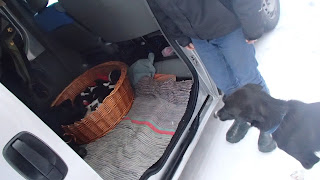
And then they all came out.... and wanted some of their Mummy's food.....
And then I had to leave them, with a variety of promises and threats for my friends to send me regular updates, pictures and videos of them. And I will definitely be going back to visit.
I'm not completely sure what their future will be. I think it was said that they will definitely keep the males, and maybe two of the females. They will then find homes for the others. Usually, in Lapland, most of the female puppies are killed. Definitely so if homes cannot be found for them- there are so many dogs and so many puppies and they are too expensive to keep. Thankfully, it has been very firmly repeated that no matter what, these puppies shall not be killed.
I can't help but think of all the others though.
We had been waiting for Leako, a pure pedigree Siberian husky, to give birth for some weeks now. She is very timid around humans, especially men, and had been ill at ease in the Mummy/ Puppy enclosure since we put her there. Finally, last night, she couldn't hold on to them any longer and she gave birth to 6 little puppies. In minus 35. 3 survived. The other 3 were frozen solid.
I felt so angry, and so sad when I heard this. We'd had a hunch that she would give birth that night; she'd been circling and pacing in a way that was indicative to beginning labour, but we were told that we should leave her alone. As I said, she is timid around humans, it was sensible to give her space to give birth in peace. And she is a real dog dog- she doesn't like being inside with humans, she prefers to be out with the pack. But that night.... it was the coldest it has been for us. Minus 35. And she hadn't been eating for a few days. If she was inside, those puppies would have survived. The owner loves his dogs, he treats them incredibly well, but he is a man of the wild. He sees the death of the puppies as natural selection. The way of nature. But, these dogs aren't wild, they are domesticated, and we do have the power to intervene with nature. And sometimes maybe we should. Even if the worth and beauty of the life of little puppies is disregarded, those puppies, being pure bred with perfect papers and incredibly clever parents, would have been worth about 1000 euroes each. What a waste.
So, it is with a slightly less upbeat tone that I turn to talk about Livza's puppies, a husky who I saw give birth to 6 weeks ago. Because now, when I reminisce and look at pictures and videos and think about how they've grown I can't help but think of Leako's three dead puppies, and how they never will. This is tough.
Livza is an Alaskan husky. The difference between Alaskan and Siberian huskies is one that not many people are aware exists (at least, I didn't before I arrived). A Siberian husky is what you would probably think of when someone says 'husky'- the classic white, grey and black colouring, the bi- colour eyes:
 |
| Lobo- part wolf and part Siberian husky. |
An Alaskan husky is not a breed, but rather (as Wikipedia helpfully informs me) "a type of dog (...) defined not by its ancestry but by its purpose, which is that of a highly efficient sled dog". So, an Alaskan husky can be any size, any shape, any colour, it is simply a dog which has been bred with many strains of dogs (including a large amount of Siberian husky) to create the fastest, strongest, most intelligent racing dog. So all of the below dogs, whilst looking very different, are all Alaskan huskies:

I digress.... Watching the birth of Livza's puppies was one of the most wonderful things that has happened in my life. Livza was bought shortly before I arrived, and we (and the previous owners) had no idea that she was pregnant at the time. We thought it strange that she suddenly lost interest in running, but thought maybe she would get better again. We got worried when we saw her belly starting to swell, but thought perhaps she had just got a bone stuck. We kept an eye on her. And then we noticed that her nipples were starting to swell with milk. Unsure whether it was a real pregnancy, or a false one, we took her home with us just to keep an eye on her. (The owner was away at the time, otherwise I suppose we wouldn't have been allowed). I guess she recognised a safe place when she saw it as within a few hours of brining her into the hostel where we lived, she circled around, and quietly and without any fuss, began to give birth.
 |
| Newborn puppies suckling! |
Nine beautiful little puppies spent two and a half weeks crawling and squeeling about in the hostel. We took Livza for lots of walks, gave her lots of food, and spent so much time cuddling and stroking the puppies. 4 of them were black and white and resembled her, 2 were blonde and looked like little Polar bears, and 3 were a beautiful shade of grey and white. Then came the task of naming them, for which we were lucky to have the help of one of our boss's beautiful 5 year old daughter.....
 |
| Sofia with Livza and the puppies! |
So, we had five little girl puppies.....
 |
| Sydan ('Heart') is the blonde one. Otivar (the place in Spain where our hosts have an olive farm) is the one who is almost entirely black apart from a tiny tip of white on her tail. Kukka ('Flower') has a patch of white on her neck that looks like, well, a flower. Tahti ('Star') has a long patch of white on her neck that is pointed like a star. And Aussie is for my fellow workawayers Pam and Belinda, from Australia. We like to fancy we can see a patch of white that looks like Tazmania on her back! |
 |
| Stadi ('Helsinki')'- a long strip of white on his head that looks like the road into Helsinki! Klovni ('Clown')- Patches of white and grey and clown like eyes. Granada (the place in Spain where out hosts met) and finally 'my' one... Big Ben (also known as Champ(agne), the light blonde one who looks like a baby Polar bear.... He was going to be called Piggy as he was the biggest of the litter. This was then changed by little Sofia to 'Mr Big'. We then tried desperately to think of an English-y name for a puppy to represent me, which is when we decided to change 'Mr Big' to 'Big Ben'. |
 |
| Klovni |
 |
| Sydan, Kukka and Klovni |

Milestones for the puppies: Day 12- they began to open their eyes.
 |
| Me and my beautiful little Big Ben |
 |
| Stadi, walking! |
Day 18- time to take the puppies back to the farm..... Heartbreaking but time for it to happen....

And then they got in their new house......
And the bets were on as to who would be first out the house! We each chose a puppy, and if we were right everyone else would have to buy us a beer or a bar of chocolate.... I chose Tahti as she seemed to be the most curious.....
And then this happened....
Woop woop!
And then I had to leave them, with a variety of promises and threats for my friends to send me regular updates, pictures and videos of them. And I will definitely be going back to visit.
I'm not completely sure what their future will be. I think it was said that they will definitely keep the males, and maybe two of the females. They will then find homes for the others. Usually, in Lapland, most of the female puppies are killed. Definitely so if homes cannot be found for them- there are so many dogs and so many puppies and they are too expensive to keep. Thankfully, it has been very firmly repeated that no matter what, these puppies shall not be killed.
I can't help but think of all the others though.
Thursday, 29 November 2012
Northern Lights
"The Aurora blazed all of a sudden into brilliant life.... a thousand miles high and ten thousand miles long: dipping, soaring, undulating, glowing, a cataract of glory." (Philip Pullman)
It’s books that inspire me to travel. Since I was little, I have loved reading, and it’s the books that you read when you’re young that make the strongest impressions. ‘Captain Corelli’s Mandolin’ took me to Kefalonia. ‘Dracula’ to Whitby. And it was Philip Pullman’s ‘Northern Lights’ that took me to Lapland.
.JPG) I thought it was such a cliché to come here because of that book; that lots of people would have passed through here because they had the same image as me in their mind: of Lyra racing on Iorek across the icy Arctic wilderness, under curtains of flickering and dancing lights. So, it was with a little bit of embarrassment that I answered the question of ‘why Lapland?’ with ‘Philip Pullman’. Embarrassment dissolved swiftly to disbelief when it became apparent that nobody, be it my fellow volunteers or my Finnish hosts had ever heard of it.
I thought it was such a cliché to come here because of that book; that lots of people would have passed through here because they had the same image as me in their mind: of Lyra racing on Iorek across the icy Arctic wilderness, under curtains of flickering and dancing lights. So, it was with a little bit of embarrassment that I answered the question of ‘why Lapland?’ with ‘Philip Pullman’. Embarrassment dissolved swiftly to disbelief when it became apparent that nobody, be it my fellow volunteers or my Finnish hosts had ever heard of it.
Needless to say, when my family came out to visit me a little over a week ago, a dog- eared copy of ‘Northern Lights’ came in the suitcase, and now sits proudly on the Hostel bookshelf where we live. Everybody has strict instructions to read it before they leave, especially so when Wikipedia informed me that the fictional Lake Enara, from where the witch Serafina Pekkala was the Queen of, is actually based on Lake Inari, the place where I am living. On learning this, and reading the book again, everything suddenly has a new significance, and I was struck with new perspectives and feelings both about the text and this beautiful part of world.
In ‘Northern Lights’ the Aurora is a gateway into another world. Physics explains the beautiful displays of colours and lights in the Northern sky as solar particles colliding with earth's magnetic shield and encountering atoms of oxygen and nitrogen at different altitudes. For the Sámi, the indigenous peoples of the North, the Aurora was an Arctic Fox made up of light that flew through the sky, brushing aside the stars with his tail. I think the beautiful image conveyed by the Sámis captures what it’s like to experience the northern lights so much better than the scientific explanation.

The Aurora is visible here in Inari nearly every night. However, clouds obscure it, and streetlights make it fainter, so the best nights have been when it is clear and we have walked or driven out of the village’s lights to somewhere like a lake, where you can look out across to the horizon without trees obstructing the sky. A 20 minute drive outside of the village is an old bird tower, which rises 100 feet above the ground, affording panoramic views of the sky. But we’ve also seen the aurora from our window, shimmering across ghostly green lines, or just outside our front door, snaking over the roofs of where we live. Dashing into the supermarket to buy some beer, I said in excitement to the lady behind the counter that there was a beautiful aurora just outside. She looked at me with some kind of mixture of pity and derision. Our host called us up last night: “Beautiful beautiful aurora outside just by the guesthouse!”…. and then she went to bed. I can’t imagine becoming so accustomed to such an astonishing and mysterious act of nature. Conversely, for them they think it’s kind of funny that people travel from the other side of the world to see it; a local girl: “it just means the sky is lighter! You can just see better!”

I think the indifference that is shown to this natural phenomenon is kind of sad, but beginning to be apparaent even in us. At the beginning, we’d be so excited at a greenish blur under a thick layer of cloud. Now, we’re kind of picky. If it’s not really clear out, or a really active aurora (the intensity of the colours and the movement of the aurora depends on the magnetic activity and wind speed) we do tend to roll back into bed. I don’t think I’d ever get to the same level of derision, and things can also work the other way with the people who live here. A guy who has been here since he was born explained to me that working with the ‘Aurora Hunters’, a group of British guys who sell aurora tours to tourists, has actually made him appreciate the northern lights more.
 |
| The cabin I stayed overnight in |
What will certainly stay with me long after I have left Inari will be the time that I was stayed overnight at Kotiniemi, the horse and husky farm. The farm has no electricity or running water, and I was sleeping in the cabin for the night. It was beautiful. I made a fire in the stove and got the cabin cosy, lit a couple of candles, and snuggled in a sleeping bag to read a book. At about 7pm I looked out the window to see lines of green light hanging amidst the stars outside. Pulling on my coat and gloves I went outside, stood out on the frozen lake and looked up at the sky which was completely lit up by snaking green lines hanging in curtains above me, dancing and moving, some slowly and some more quickly. Reds and purples chased the edges of the thicker blocks of green, and sky was alive with colour and movement. Tendrils stretched right above my head before seeming to fall around me like rain. This continued for about an hour, and began to die away- I could then see more stars that I have ever seen in my life. Eventually I went to bed. About midnight I woke up, looked outside, and it had begun again. I watched for another hour in awe; the place where I worked everyday with the horses and dogs was transformed into what looked like another world. I woke up again at 4am, and then again to start feeding the horses at 7.30am. Both times the aurora was shimmering outside. It was one of the best displays I had seen. I’m not sure if I’m sad or not that there was nobody with me to share that experience. I think it meant more, and affected me more, because of the fact that I was alone.
I think it was meant to happen like that.
I think it was meant to happen like that.
"She was riding a bear! And the Aurora was swaying above them in golden arcs and loops, and all around was the bitter Arctic cold and the immense silence of the North." (What brought me here. Lyra in 'Northern Lights')
 |
| Oh, and did I mention, we've started running horse sledding aurora tours. Awesome. |
A day in the life...
So people keep asking me what I’m actually doing here, so I
thought I’d give a quick run down of typical working day. The idea of doing this has been shamelessly stolen from a fellow French workawayer but hey ho :D
(If we have people staying in the guesthouse)- 7am- I put the bread in the oven and prepare the breakfast for the guests, and for us!
8am: Breakfast. We meet and plan the day, and then travel to Kotiniemi, the horse and husky farm.
9am- Driving slowly in the shy Arctic dawn, we first check that none of the huskies or horses have escaped.... We try our best to make sure that they are all safely inside the pen, but accidents sometimes happen (a husky once escaped and killed nine reindeer before it was found!) and for the horses, sometimes the lure of hay is just too much......
If the horses have decided to wait for us until they get hay, we begin to feed them. In the summer and autumn, the horses drink at the lake, but at the moment the lake has frozen so we make sure there is water in their water trough. We then light a fire underneath it- our average temperate is about -15 at the moment. Any water left outside is ice within minutes.
10am- Check on our pregnant husky, our mummy husky and her nine beautiful puppies! What an awful task.... ;)We feed and water them and clean up some poo, and make sure they are comfortable. The puppies are beginning to eat their mum's meat now as well! (something she is not too happy about!)
10.30am- Poo time! Sleds full of horse poo, chipping it away from the frozen ground (or covering with snow the particularly stubborn bits) Not the best job in the world, but very important!
 |
| One morning we arrived to this.... |
10am- Check on our pregnant husky, our mummy husky and her nine beautiful puppies! What an awful task.... ;)We feed and water them and clean up some poo, and make sure they are comfortable. The puppies are beginning to eat their mum's meat now as well! (something she is not too happy about!)
 |
| Sydan (meaning 'heart' in Finnish) enjoying a tasty bit of reindeer meat! |
11am- Time for the dogs! Better than the horse poo, there is not as much, and the dogs are just so happy to see you. Barking with excitement when you arrive, licking, jumping, hugging you, squealing with indignation when you pay another dog more attention....
11.30am- Time for dog sledding! We might have clients, or we might be training the dogs on a new track. First we select the teams and then put the harnesses on. We then connect the dogs to sleds, "Odota! Odota!" (Wait! Wait!), we try everything we can to calm the dogs down as they jump and squeal and try as hard as they can to run, now! This is a time full of energy and excitement, and just as you think you can't keep these dogs calm any longer, it's MENA MENA, GO GO GO! Jumping onto the sled, the first few seconds are full of thoughts about not falling off as we rush down the track at near to 40km/hr....

12.30pm- Lunchtime! We go to the Laavu, a traditional Sami tent to start a fire, grill some sausages and make a nice cup of tea :) We also feed the mummies and puppies again.

1.30pm- It's the horses turn! We might have a client, or we might take the afternoon to chop firewood or fix things around the farm, but on good days it's both horses and huskies. Some people go in the sleds, and some ride. I prefer to ride- much more interesting, and so much warmer!

2.30pm- Time to feed the dogs- a concoction of dog biscuits, reindeer meet and a broth made out of bones. Each dog must sit and wait until we give the command to eat ('Vappa!'). Not too difficult with the older dogs, but a nightmare with the younger ones!
3.30pm- Feed the horses and do a final poo run.
4pm- It is pitch black by now, and we pack up the car and head back to village. We then spend the evening ice skating, drinking tea, or (more usually now!) arguing about whose turn it is to cook dinner! If there's clients the next morning for breakfast I make the bread ready, and if it's a clear night we go aurora hunting, otherwise we chill out, or go down to the pub.....
Sunday, 11 November 2012
Life in the frozen north
I
have now lived in Inari, Lapland, in the far north of Finland, for
just over 6 weeks. In what is, all things considered, quite a short
amount of time, I have watched the landscape change a phenomenal
amount. I arrived during the ´ruska´, the finnish name for the
explosion of autumn colours on the trees. In what followed I saw an
incredible amount of rain and sun, and the leaves gradually begin to
fall from the trees. We then had a week in which everything around us
froze. Puddles began to ice over, a frost was on the ground, and
winter in the air. The weather forecast predicted ´a light dusting´
of snow to fall overnight. We woke up to about 20cm. Thick drifts of
snow lined the streets and the lake began to freeze. The entire
landscape will now be white until May, at which point it will finally
begin to thaw. Sometimes, if alot of snow has fallen that winter, it
doesn´t disappear until July.


The
changes of the seasons were stunning to watch for me, but it was even more
astounding for another volunteer who was here from Columbia. For her,
it is warm all year round. There are no seasons, apart from a
slightly rainier one, and a slightly drier one. The changes of the
landscape here, the trees and the lakes was one that was completely
incredible for her. She arrived in August, in temperatures of
27degrees. She then watched it change with me, to something of the
other extreme. It is beautiful.
Trust
an English(wo)man to talk about the weather...... So what am I actually doing
here?! Well it is pretty awesome, working with huskies and horses. I found out about it on www.workaway.info,
an incredible work exchange website in which people from all over the
world post up things that they need people to help them do. These
range from working on farms, being a babysitter, an au pair,
gardening, cleaning, working in a hotel, a guesthouse... pretty much
anything. All from people in some of the most beautiful and
incredible places in the world. You don´t get paid, but you get all
of your accommodation and meals for free, and you actually get an
insight into the local culture as you´re living or working with a
host family. It´s really nice to be able to stay in one place for a
little bit, and to be able to walk into the supermarket, or the pub,
and people to recognize you and say hello. You´re no longer treated
as a tourist, but as a local. You get to know the people who live
here, and what it is like to live in a place like this. Anybody who
is at a loose end, or wants to go travelling but doesn´t really have
much money, I would urge and urge and urge you to check out the
website, it is wonderful!The people I stay with own a guesthouse, a hostel, and a shop as well as the horse and husky farm, so there's so many things to get involved in. We (the volunteers) actually live in the hostel which is really cool, as we often have travellers coming through and staying there, so are contantly meeting some really interesting and funny people. I was considering hitching from Rovaniemi to here in Inari, as the bus was a stupid amount of money, but was kind of glad I didn't when a rather bedraggled German guy rocked up to the hostel and said that he had waited 10 hours for a lift! Which, whilst sounding ridiculous, is somewhat easy to believe, the roads around here are very empty and you can sometimes go hours without seeing a single car go by.
I'm currently working with two australian volunteers, a Columbian and a dutch girl, and we're due a French guy to turn up in a week or so's time. I'm lucky, as with some experience of horses and horse riding I was dubbed 'horse girl' and so I'm out at the farm working with the horses and dogs pretty much every day, rather than stuck manning the giftshop or cleaning rooms in the guesthouse! Horse girl has been given the task of training a 2 year old horse to be good to ride, which is kind of hilarious in many ways as whilst I can horse ride and have looked after horses I have never done anything like that before! But it means that I am fulfilling my childhood fantasies of being like the girls I read about in my many (many) horsey books and having my own horse going on adventues.....
There's so many stories and anicdotes and things I've done that there simply isn't space or time. We've had many campfires in the wilderness. We've rolled in the snow naked and then gone into the sauna. I went to the most northen point of mainland Europe and swam in the Arctic ocean. I watched a dog give birth to 9 beautiful puppies right in the middle of our living room floor.
Maybe pictures capture things best. Here's a few of my favourties.


Tuesday, 6 November 2012
The Fin(n)ish
Before arriving in Finland I was warned
by the rest of Scandinavia that the Finnish were a strange people.
They liked to drink. They didn't say much. They were a little bit
'not quite right in the head'. Sounded interesting.
My impressions of the Finnish people were a little mixed at the this point. I wasn't sure if my Swedish friends had an point afterall... But hey, I thought, let's see what happens. My next stop was my final stop for a couple of months- playing with huskies and horses in Inari, Lapland, 6 hours north of the Arctic cirlce!
There certainly does seem to be a certain
aminosity between the rest of Scandinavia and Finland - much of it of
which I'm sure is in a joking way (in the same way Britain and France
have a certain 'rivallry'.) The girls I met in Bergen though said
Finland liked to think they were part of Scandinavia... but really
they weren't. They were 'different'. I guess a big thing is the
language. Whereas Swedish, Danish and Norwegian are all very very
similar, to the point where the people from each country can all talk
with each other with relative ease (similar to the difference between
a London and a Glaswegian accent- it takes some getting use to, and
each use some slightly different words, but it is completely possible to
understand each other) Finnish, on the other hand, is utterly different. It has been most likened to Hungarian (something
which I'm not entirely sure how has come about) and is about as different from the other Scandinavian languages as English is. I guess another
thing which has made everyone else look at Finland a bit funny has been its proximity to Russia, and the long histories of
wars and conflicts there. My Swedish friends complained that the
Finnish people are generally very withdrawn- almost sullen. My
couchsurfing host in Rovaniemi told me about how the Nazis razed
Lapland to the ground. And then there was another war with Russia.
And another. Finland has had a very long war history, and those kind of things really must make a difference. Especially
compared to Sweden who simply does not have any kind of experience of war.
Nevertheless, I didn't like Helsinki.
It was cold, it was tired looking, there was not that much to do. In
the top 10 'things to do in Helsinki' list, number 4 was 'Go to
Tallinn (Estonia) for the day!'. So that's what I did.... Just a 2
hour ferry journey away and I was in the beautiful little old town of
Tallinn. Helsinki did have some nice spots, and a stunning cathedral.
I also couchsurfed with a lovely couple who lived by the sea- I
cooked my vegetable lasagne for them (classic) with mushrooms that
they had picked from the forest the previous weekend and we laughed
and chatted and took their cute dog for a walk around the area. I
met up with Connie- the girl I had met in Bergen, and we spent
an afternoon taking funny pictures in the city centre. But.... I was
eager to leave. Helsinki struck me as a place where you lived, or
worked. But not a place eager for tourists.
 |
| Helsinki Cathedral |
 |
| Wonderful couchsrufing hosts |
 |
| Tallinn |
So I decided to get out of there a day
early and, rather than get the train, grab a cheap flight up to
Rovaniemi- the gateway to the Arctic circle, the capital of Lapland, but more importantly- the home of Santa Claus. I arrived with the announcement on the plane
“Welcome to Rovaniemi. The weather here is.... well the same as
Helsinki. Wet and cold.” Nice. I dislked Rovaniemi as well. It was concrete block after
shopping mall after concrete block. I'm sure the wet and cold didn't
help matters but it was a depressing place. Even Santa's village
seemed a little bit sad- but that was probably because I was the only
person on the 'Santa Express' that runs from the town to his village,
and it was just kind of grey and drizzerly outside. Not the best for
Christmas cheer or winter wonderland vibes. It was a cool experience though- all of the people
that work there in the shops are dressed in little elf costumes- my
couchsurfing host there actually used to work as one (she complained
bitterly about having to smile and be a jolly elf in the face of rude
spoilt kids). There's also even a postroom where you can write a
letter to Santa, and you can also pay for him to send a letter back!
I then went on through Santa's workshop to meet the man himself. A
polylingual genius, Santa can seemingly speak any language- he was
chatting away to a Japanese couple in front of me, and when it was my
turn to go through to his study he turned what could have been a
rather awkward few minutes of sitting with a random Finnish man to a
hilarious experience.
 |
| A photo with Santa? 25 euroes. A video? 50 euroes. Taking a picture of your video when the elf's back is turned? Priceless. |
Rovaniemi....
I visited a very good Arctic museum, I ate at the Northenmost
McDonalds in the world, and visted 'Lordi Square', dedicated to the
Finnish heavy metal band from Rovaniemi who won Eurovision about 5
years ago. My host took me to a Short Film cinema club she'd
organised, and a club night where I got poured the poorest excuse for
a pint I have ever seen. It was nice, but I wouldn't go back.
My impressions of the Finnish people were a little mixed at the this point. I wasn't sure if my Swedish friends had an point afterall... But hey, I thought, let's see what happens. My next stop was my final stop for a couple of months- playing with huskies and horses in Inari, Lapland, 6 hours north of the Arctic cirlce!
Subscribe to:
Posts (Atom)